Jellyforce blog
Ashwagandha, Maca and Arginine: What the Research Actually Says
Three of these five ingredients have been studied properly. None of those studies used 82 milligrams.
Start here
Three of five have been studied
Three of the five ingredients in this formula have been studied in humans. Two have barely been studied at all. That is a better ratio than much of this category manages, and it is worth going through one at a time rather than lumping them together.
One thing to hold throughout: none of this research was conducted on this formula, and none of it used 82 mg of a five-way blend. Citing a study about an ingredient is not evidence about a product, and the difference is the whole point of this post.
Ingredient 1
Ashwagandha: the best-supported one
Ashwagandha (Withania somnifera) is the ingredient here with the clearest modern research record, and it is not primarily a vitality herb.
NCCIH's review is specific: some ashwagandha preparations may be effective for insomnia and stress, while findings on anxiety remain unclear. That is a careful sentence and it is worth reading exactly as written — it says some preparations, it says may, and it names two outcomes rather than a general improvement.
Why does a stress and sleep ingredient appear on a vitality label? Because the honest route to feeling more capable in the afternoon often runs through sleeping better and being less wound up. That is a real mechanism and a quieter claim than the front of any jar in this category implies.
The safety note that comes with it
NCCIH also reports a number of cases linking liver injury to ashwagandha supplements, describing them as rare. That is the single documented safety signal in this formula, and it is the reason we keep saying the ashwagandha amount should be published: a rare risk attached to an unknown quantity is harder to reason about than a rare risk attached to a known one.
Ingredient 2
Maca: the most-studied botanical
Maca (Lepidium meyenii) is a root vegetable grown high in the Peruvian Andes, where it is eaten as a food rather than taken as a supplement. That matters, because a food eaten in quantity and an extract taken in milligrams are different propositions.
It is the most-studied botanical in this formula and the one most people recognise. The published human work is generally conducted on dried root measured in grams — commonly 1.5 to 3 grams a day — which is the figure to hold when you read a supplement label that lists maca among several ingredients.
What we are not going to do is summarise what those studies found, because the honest summary is that the literature is mixed, the trials are mostly small, and none of it was conducted at anything like the amount in this jar. Anyone offering you a confident one-line conclusion about maca is compressing a messy body of work into something it does not support.
The useful takeaway is the unit. Grams. Not milligrams.
Ingredient 3
L-arginine: real chemistry, awkward evidence
L-arginine is the one with the cleanest mechanism and the most awkward evidence, and it is worth separating those two things.
The mechanism is real. L-arginine is a semi-essential amino acid, the body converts some of it to nitric oxide, and nitric oxide relaxes the smooth muscle in blood vessel walls. That is textbook physiology and it is the chemistry the entire category's circulation story rests on.
The evidence is not. NIH's Office of Dietary Supplements puts it about as plainly as a federal fact sheet ever does: there is little scientific evidence to support taking arginine supplements to increase strength, improve performance, or help tired and sore muscles recover after exercise.
That sentence is about athletic performance rather than about this category specifically, and it is the most relevant published assessment available for supplemental arginine's effect on how a body performs. It is also worth noting that the amounts behind that assessment run to grams a day. If several grams produce little measurable effect, a share of an 82 mg blend is not going to.
The interaction worth knowing
Because L-arginine relaxes blood vessels, it can lower blood pressure. Anyone taking nitrates, blood-pressure medicine or ED medicine should raise it with a clinician before starting, and that is true of every arginine-containing product, not just this one.
Ingredients 4 and 5
Muira puama and catuaba: tradition only
Muira puama (Ptychopetalum olacoides) and catuaba are both South American barks with long traditional use in Brazil, where they are commonly sold together. They are the two ingredients here with essentially no controlled human research behind them.
That is not a reason to dismiss them, and it is a reason to be precise about what you are buying. Traditional use is a genuine fact about a plant: people have used it, for a long time, for something. It is a much weaker fact than a trial, and the honest word for it is tradition rather than evidence.
Catuaba has an additional problem. It is not one plant. Several different trees are sold under that name — Trichilia catigua and Erythroxylum vaccinii among them — and a label that does not name the species has not told you which one is in the jar. This one does not.
NIH's Office of Dietary Supplements makes the general point that for most botanicals, the constituents responsible for their effects are not known. For these two, that applies with particular force.
The comparison
The amounts every one of these studies used
| Ingredient | Commonly studied at | In Jellyforce |
|---|---|---|
| Maca | 1.5-3 g a day of dried root | Share of 82 mg extract, not published |
| L-arginine | 1.5-6 g a day | Share of 82 mg extract, not published |
| Ashwagandha | 300-600 mg a day of root extract | Share of 82 mg extract, not published |
| Muira puama | No agreed dose | Share of 82 mg extract, not published |
| Catuaba | No agreed dose | Share of 82 mg extract, not published |
The right-hand column is identical on every row. That is the finding.
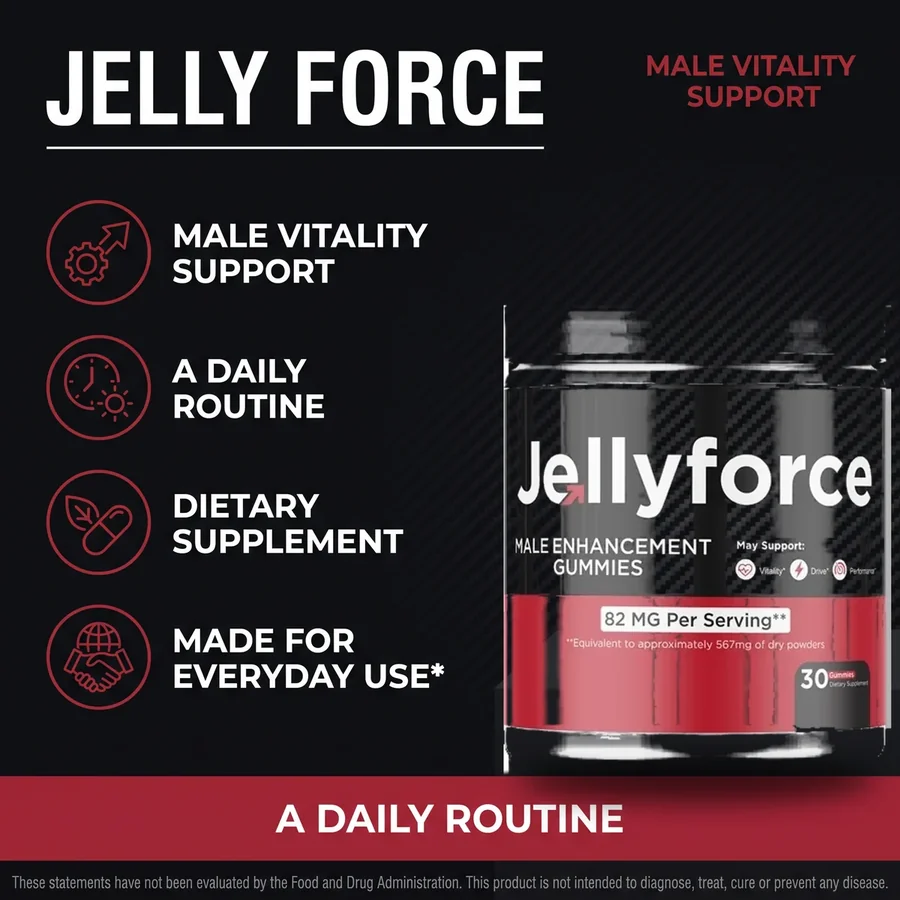
The label's own footnote puts the whole serving at approximately 567 mg of dry powder. Split five ways that averages about 113 mg each — below the ashwagandha range, an order of magnitude below the maca range, and more than an order of magnitude below the arginine range.
We keep repeating that arithmetic because it is the single most useful thing anyone can tell you about this formula, and because no other page about this product is going to.
Summary
What that leaves you with
Three ingredients with research, two with tradition, and a blend total that sits below the studied range for all three of the first group.
That is not a scandal. It is an extremely common shape for a supplement in this category, and this label is more honest than most about it — it prints the number, it prints the dry-powder conversion, and it says may support rather than promising anything.
What it means for you is simple. Buy this as a daily habit built around ingredients with real traditional standing and, in two cases, real research interest. Do not buy it expecting the effect sizes in the studies, because the studies did not use these amounts.
And if what you actually want is the ashwagandha effect on sleep and stress, or the arginine effect on circulation, a single-ingredient product at the studied amount is the honest way to get it — from us or from anyone else.
References
Sources
- National Center for Complementary and Integrative Health. Ashwagandha: Usefulness and Safety. www.nccih.nih.gov. Accessed September 22, 2026.
- NIH Office of Dietary Supplements. Dietary Supplements for Exercise and Athletic Performance. ods.od.nih.gov. Accessed September 22, 2026.
- NIH Office of Dietary Supplements. Botanical Dietary Supplements: Background Information. ods.od.nih.gov. Accessed September 22, 2026.
- National Center for Complementary and Integrative Health. How To Find Information About Complementary and Integrative Health Practices on PubMed. www.nccih.nih.gov. Accessed September 22, 2026.
- National Center for Complementary and Integrative Health. Using Dietary Supplements Wisely. www.nccih.nih.gov. Accessed September 22, 2026.
Order Jellyforce from the official page
Published prices run $49 to $89 a bottle with a 60-day money-back window and an order desk on +1 (302) 200-3480. No ingredient amount is published, and you should know that before you pay.
60-day money-back window · ships from inside the US · order desk +1 (302) 200-3480