The two with real research records
Maca and ashwagandha. Both have been studied properly in humans. Both were studied at amounts far larger than this whole blend, which is the fact this page keeps returning to.
Official product information
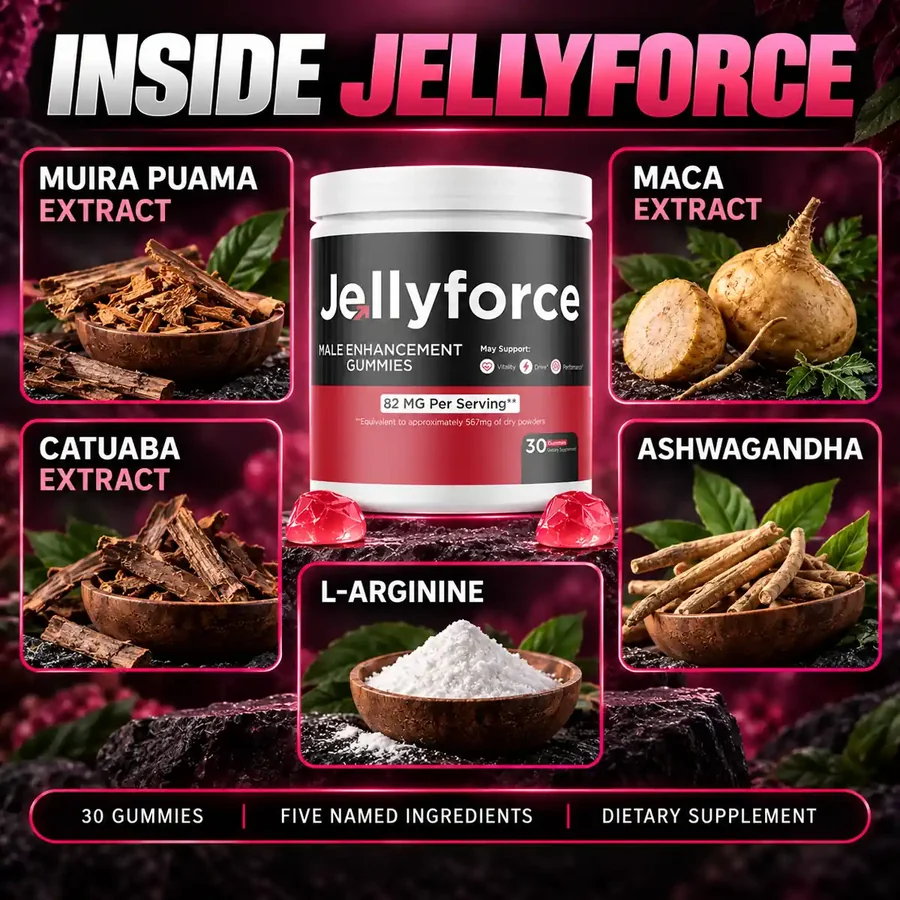
All five ingredients named on the Jellyforce packaging, what each one is, what published research used, and the split the label does not give you.
Written and reviewed by the Jellyforce Editorial Desk · Last updated September 22, 2026
Quick answer
Jellyforce names five ingredients: muira puama extract, maca extract, catuaba extract, ashwagandha and L-arginine. The jar prints one strength for the whole blend — 82 mg a serving, footnoted at about 567 mg of dry powder. No individual amount is published, so no single ingredient can be compared with the research on it.
The list
Five ingredients are named on the Jellyforce packaging, and all five appear on the seller's own ingredient card. That is worth something: a great many products in this category name nothing at all and hide behind the words “proprietary blend”.
The jar also prints a strength, which is rarer still. 82 mg per serving, footnoted as roughly 567 mg of dry powder. Most of this market gives you no number to work with.
What it does not give you is the split. How 82 mg divides across five ingredients is published nowhere, which means a comparison can be made for the blend and cannot be made for any single ingredient in it. Each card below ends the same way, for that reason.
All five
Tap any card to open it. Each one gives what the ingredient is, why it plausibly belongs here, and the amount.
Muira puama extract
The traditional Amazonian root the formula is named around.
Muira puama (Ptychopetalum olacoides) is a small Amazonian tree. Its root and bark have been used in Brazilian traditional practice, where it is sometimes called "potency wood".
It is the ingredient that signals the category. Traditional use is real and long. Controlled human research is very thin, and none of it tested 82 mg of a five-way blend.
Amount in Jellyforce: not published Research reference: No agreed research dose
Maca extract
A Peruvian root vegetable, the best-known name on this label.
Maca (Lepidium meyenii) is a root vegetable grown high in the Peruvian Andes and eaten as a food there. Supplements use dried root powder or a concentrated extract.
Maca is where most of this category's research interest sits. The amounts used in published human work are measured in grams a day of dried root, which makes the arithmetic on this label worth doing.
Amount in Jellyforce: not published Research reference: Commonly 1.5-3 g a day of dried root in trials
Catuaba extract
A second Brazilian bark, usually paired with muira puama.
Catuaba is a name used for the bark of several South American trees, most often Trichilia catigua or Erythroxylum vaccinii. Which species a supplement uses is often not stated.
It almost always appears alongside muira puama, because the two are sold together in Brazil. Human evidence is close to absent, and the species is not named here.
Amount in Jellyforce: not published Research reference: No agreed research dose
Ashwagandha
The one ingredient here with a real body of human research.
Ashwagandha (Withania somnifera) is a shrub used in Ayurvedic practice. Most modern supplements use a standardised root extract.
NCCIH reports that some ashwagandha preparations may be effective for insomnia and stress, and that findings on anxiety are unclear. It also notes a number of cases linking liver injury to ashwagandha supplements, described as rare.
Amount in Jellyforce: not published Research reference: Commonly 300-600 mg a day of root extract in trials
L-arginine
An amino acid the body uses to make nitric oxide.
L-arginine is a semi-essential amino acid found in meat, nuts and dairy. The body converts some of it to nitric oxide, which relaxes blood vessels.
This is the ingredient behind the label's circulation wording. NIH's Office of Dietary Supplements is blunt about the performance claim: there is little scientific evidence that arginine supplements increase strength or improve performance.
Amount in Jellyforce: not published Research reference: Commonly 1.5-6 g a day in trials
Side by side
| Ingredient | What it is doing here | Amount in Jellyforce | Research reference |
|---|---|---|---|
| Muira puama extract | The traditional Amazonian root the formula is named around. | not published | No agreed research dose |
| Maca extract | A Peruvian root vegetable, the best-known name on this label. | not published | Commonly 1.5-3 g a day of dried root in trials |
| Catuaba extract | A second Brazilian bark, usually paired with muira puama. | not published | No agreed research dose |
| Ashwagandha | The one ingredient here with a real body of human research. | not published | Commonly 300-600 mg a day of root extract in trials |
| L-arginine | An amino acid the body uses to make nitric oxide. | not published | Commonly 1.5-6 g a day in trials |
Reference ranges are general and depend heavily on the preparation used. They are not a claim about this product and not drawn from a trial of it, because no trial of it exists.
Our reading
Four groupings. One is a compliment and three are not.
Maca and ashwagandha. Both have been studied properly in humans. Both were studied at amounts far larger than this whole blend, which is the fact this page keeps returning to.
L-arginine. The chemistry is real — the body makes nitric oxide from it and nitric oxide relaxes blood vessels — but NIH's Office of Dietary Supplements says plainly that there is little evidence arginine supplements improve strength or performance.
Muira puama and catuaba. Both are South American barks with long use in Brazil and very little controlled human research. On catuaba the label does not even name which species it is, and several different trees are sold under that name.
No gelling agent is named, which on a gummy is not a small omission. No sweetener, no colour, no sugar figure, no allergen line and no extract ratio for any of the three botanicals.
The honest section
NIH's Office of Dietary Supplements makes a point that lands directly on this label: US law does not require dietary supplements to be standardised, and there is no legal or regulatory definition of the term in the United States. It adds that for most botanicals the constituents responsible for their effects are not known.
Put that beside a blend total with no split and you get two unknowns stacked. You do not know how much of each plant you are taking, and for most of these plants nobody knows exactly which compounds matter. The second one is nobody's fault. The first is a printing decision.
If any of those appear, this page changes and the date at the bottom of it moves forward. That is the whole correction policy.
Questions
Jellyforce is a dietary supplement sold as a chewable gummy. The jar label prints "MALE ENHANCEMENT GUMMIES", "May Support: Vitality, Drive, Performance", 82 MG per serving and 30 gummies. Five ingredients are named: muira puama extract, maca extract, catuaba extract, ashwagandha and L-arginine.
Not published. The label prints one number for the entire blend and does not say how the 82 mg divides across the five ingredients. We say so on every page rather than filling the gap with a guess.
No. Published human research on maca uses grams a day of dried root, and trials on ashwagandha extract commonly use 300 to 600 mg of that single ingredient. The whole Jellyforce blend is 82 mg of extract, or about 567 mg of dry powder, shared five ways.
It is the total weight of extract in one serving of the whole formula. The label adds a footnote: "Equivalent to approximately 567mg of dry powders", which is the amount of raw plant material that extract was concentrated from.
It is the one ingredient here with a documented safety signal. NCCIH notes a number of cases linking liver injury to ashwagandha supplements, described as rare. Stop and call a clinician if you notice yellow skin or eyes, dark urine or unusual tiredness.
A vegetarian seal appears on the packaging. Note that gummies often use gelatin, which is animal-derived, and the gelling agent is not named on this label either way. That is a fair question for the order desk.
References
Published prices run $49 to $89 a bottle with a 60-day money-back window. Order desk +1 (302) 200-3480.
60-day money-back window · ships from inside the US · order desk +1 (302) 200-3480