Official product information
Jellyforce Supplement Facts: Everything the Jar Prints
Everything printed on the jar, exactly as printed, followed by the nine things that are not printed and why each one would have helped.
Written and reviewed by the Jellyforce Editorial Desk · Last updated September 22, 2026
Quick answer
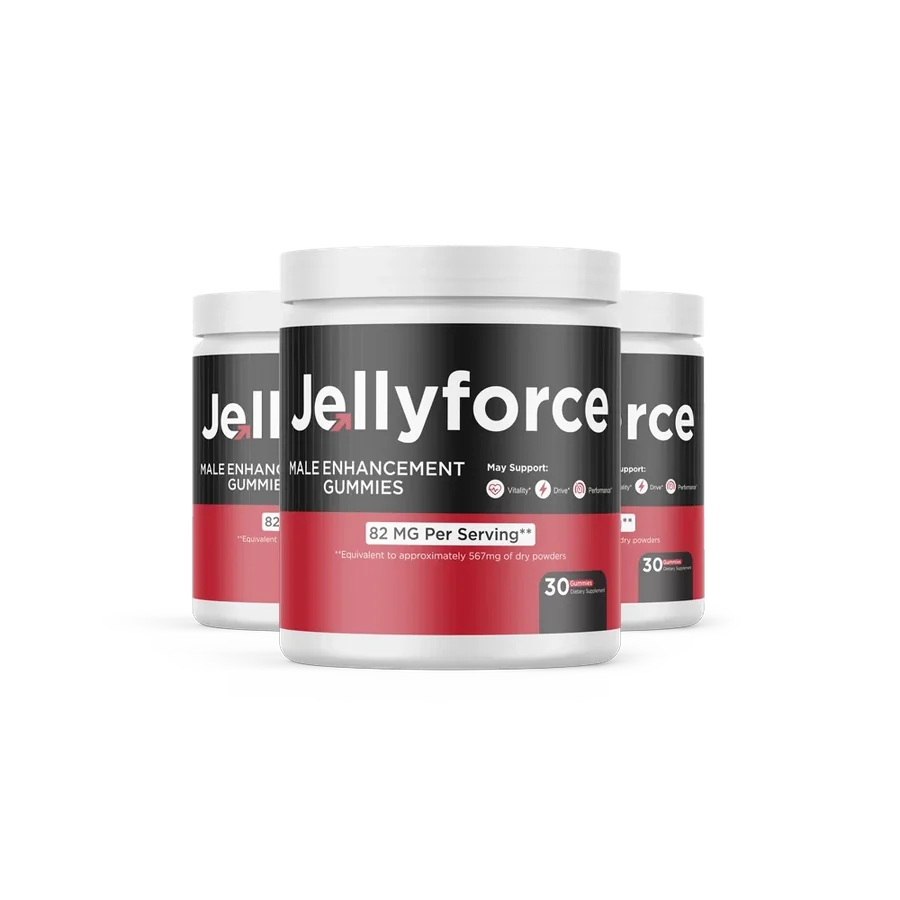
The Jellyforce jar prints the wordmark, “MALE ENHANCEMENT GUMMIES”, three icons reading Vitality, Drive and Performance under the words “May Support”, the figure 82 MG Per Serving, the footnote “Equivalent to approximately 567mg of dry powders”, and 30 gummies · Dietary Supplement. It does not print how the 82 mg divides, or how many gummies make a serving.
Word for word
What the Jellyforce label prints
There is no Supplement Facts panel image in the material supplied to us. Rather than draw one, this page prints what is actually on the jar, exactly as it appears, and then lists what is not there.
Printed on the jar, word for word
- “Jellyforce”
- “MALE ENHANCEMENT GUMMIES”
- “May Support: Vitality* · Drive* · Performance*”
- “82 MG Per Serving**”
- “**Equivalent to approximately 567mg of dry powders”
- “30 Gummies”
- “Dietary Supplement”
That is the complete printed record on the front of the container. Five ingredient names appear on the seller's ingredient card. Everything else on this site is the seller's product pack, arithmetic from those numbers, or an outside source we have linked.
What the two numbers mean together
82 mg per serving is the weight of extract in one serving of the whole formula. The double asterisk points at “Equivalent to approximately 567mg of dry powders”, which tells you how much raw plant material that extract was concentrated from. It is a useful, honest footnote and more than most labels give you.
The honest section
What the Jellyforce label does not print
Nine items. The first two are the ones that change what you are buying.
| Missing from the label | Why it matters |
|---|---|
| The ingredient split | Five ingredients share 82 mg. Without the split, no single ingredient can be compared with the research on it. |
| Serving size in gummies | Thirty gummies at one a day is a month. At two a day it is a fortnight, and the jar costs twice as much to use. |
| Other ingredients line | A gummy is mostly its base. The gelling agent, sweetener and colours are all unnamed, which also leaves the vegetarian claim resting on a seal alone. |
| Sugar or carbohydrate content | Relevant to anyone managing blood sugar, and a normal line on a chewable. |
| Extract ratios | A 10:1 extract and a 1:1 extract are very different products at the same weight. No ratio appears for any of the three botanicals. |
| The catuaba species | Several different trees are sold as catuaba. Which one is in here is not stated. |
| Allergen statement | The seals cover gluten and dairy. A printed allergen line would be clearer, particularly on a food product. |
| A price | No pack price appears anywhere before checkout in the material supplied to us. |
| A certificate of analysis | A draft reference is printed. The document behind it has not been published. |
The rules
What each claim is allowed to mean
The three icons on the jar sit under the words May Support, and that phrasing is doing careful legal work. All three are structure/function claims: statements about supporting the normal structure or function of the body, which is the category of claim US law permits a dietary supplement to make.
“May support vitality” is a structure/function claim. “Treats erectile dysfunction” would be a disease claim and would be illegal on a supplement label. Jellyforce does not make one, and that is worth crediting, because plenty of pages in this category edge right up to the line.
The trade for being allowed structure/function claims is the disclaimer in the footer of every page here: these statements have not been evaluated by the Food and Drug Administration, and the product is not intended to diagnose, treat, cure or prevent any disease. The FDA's own consumer page gives the reason plainly — it is not authorised to approve dietary supplements for safety and effectiveness before they are marketed.
About the phrase on the front
The jar also prints the words Male Enhancement Gummies. That is a category description rather than a claim about an outcome, and we quote it because it is on the label. It does not mean the product treats anything, and nothing on this site should be read that way.
Reference
The label in eight boxes
30 gummies, wide-mouth
82 mg a serving, whole blend
about 567 mg
not printed
5 named, 0 individual amounts
JEL-26/JA-3656 (draft)
Healthy adults 18 and over
Dietary supplement
Fair is fair
What this label gets right
It is worth saying what this label does better than its neighbours, because a page that only criticises is as useless as one that only flatters.
It prints a number. Walk through this category and count how many front labels give you a milligram figure at all. Most give you a name and a promise. A printed 82 mg is a thing you can reason about, argue with and compare, and this whole website's dosage section only exists because that number is there.
It prints an honest footnote. The 567 mg dry-powder equivalent is the kind of line a manufacturer includes when it expects someone to check the maths. Concentrated extract weights look small next to whole-herb research amounts, and this footnote is the label pre-empting that objection rather than hiding from it.
It stays inside the law. May support. Three icons. No disease claim, no cure language, no before-and-after imagery. In a category the FDA maintains a public warning list for, that restraint is not nothing.
None of that makes 82 mg a large amount. It does mean the label was written by someone who knew the rules, and that is a better starting point than most.
Arithmetic
The one calculation this label lets you do
Two numbers are printed and they let you do exactly one sum: the blend total against its dry-powder equivalent. Eighty-two milligrams of extract, from roughly 567 mg of dry powder, which is an extract ratio of about 7:1 for the formula as a whole.
That is genuinely useful, and it is more than most labels in this category give you. It tells you the concentration, which is the number people most often get wrong when comparing a supplement against research conducted on whole herb.
What it does not let you do is the sum everyone actually wants: how much maca, how much ashwagandha, how much arginine. That needs the split, and the split is not there.
It also does not let you work out what a jar costs to use, because that needs a serving size in gummies and a price, and neither is published.
Questions
Jellyforce FAQ: supplement facts questions
What does "82 MG per serving" mean?
It is the total weight of extract in one serving of the whole formula. The label adds a footnote: "Equivalent to approximately 567mg of dry powders", which is the amount of raw plant material that extract was concentrated from.
How many gummies are in a jar?
Thirty. That figure is printed on the front of the jar, bottom right, next to the words "Dietary Supplement".
How many gummies a day?
Not published in the material we were given. Do not guess upward: take what the jar's own directions say, and if the jar is unclear, call +1 (302) 200-3480 before you start.
Is it FDA approved?
No dietary supplement is. The FDA is not authorised to approve supplements for safety and effectiveness before they are sold. A seal reading "FDA-registered facility" describes a factory's registration, not the product.
Is there sugar in it?
Not published. A chewable gummy normally contains a sweetener and a gelling agent, and neither is named in the material supplied to us. If you are managing blood sugar, call the order desk on +1 (302) 200-3480 before you buy.
Is it vegetarian?
A vegetarian seal appears on the packaging. Note that gummies often use gelatin, which is animal-derived, and the gelling agent is not named on this label either way. That is a fair question for the order desk.
References
Sources for this page
- U.S. Food and Drug Administration. Information for Consumers on Using Dietary Supplements. www.fda.gov. Accessed September 22, 2026.
- NIH Office of Dietary Supplements. Dietary Supplements: What You Need to Know. ods.od.nih.gov. Accessed September 22, 2026.
- NIH Office of Dietary Supplements. Botanical Dietary Supplements: Background Information. ods.od.nih.gov. Accessed September 22, 2026.
See Jellyforce with the label in front of you
Published prices run $49 to $89 a bottle with a 60-day money-back window. Order desk +1 (302) 200-3480.
60-day money-back window · ships from inside the US · order desk +1 (302) 200-3480